

My Summary
This work focuses on the practical aspects of working with LLMs in the real world and downstream NLP tasks.
So we can consider this paper as a beginner's guide ,though the user maybe unfamiliar with LLMs.
Evaluation Index
- Natural Language Understanding (NLU): Enhence the exceptional generalization ability of LLMs.
- Generation: The quality of generation
- Knowledge-intensive tasks: a bit like fine-tuning
- Reasoning ability: a bit like interpretable learning?
- Real-world scenarios: the practical usage
1. Practical Guide for models
- Decoder-only: GPT-3, BERT
- Encoder-Decoder architectures: Google has made contributions and this direction still remains promising
Three types of the LLM:
- non-causal attention language models
They are encoder-only models and adapt the approach of predicting masked words in a sentence while considering the surrounding context.
All input tokens are visible to each other in the attention mechanism, which does not follow the casualty of language.
Representative models: BERT and RoBERTa.
- Decode-only Models: GPT-style Language Models
These models are typically task-agnostic in architecture and these methods require fine-tuning on datasets of the specific downstream task.
These methods are causal attention language models and are called autoregressive models.
- causal attention language models
How to choose LLM architecture?
If the task relies on capturing bidirectional contexts, such as Named Entity Recognition or document classification, then Encoder-only models like BERT and RoBERTa may be more suitable.
If the task focus is on generating text like translation or summarization, then Decoder-only or Encoder-Decoder models like GPT-series and BART-series could be more beneficial.
2. Practical Guide for Data
- Pre-training Data
The pre-training data needs some vital characteristics: quality, quantitative, and the diversity of pre-training data.
- Fine-tuning Data
Zero annotated data: In scenarios where annotated data is unavailable, utilizing LLMs in a zero-shot setting proves to be the most suitable approach. I think that Zero-shot learning can solve the OOD problem.
Here is an example: The model uses the datasets that contain horses, cats and dogs. However, the task is aimed to identify the zebra. So we will tell some features to the model that
Few annotated data: This type of data is suitable for one-shot learning or few-shot learning, which is called in-context learning.
LLMs are more versatile w.r.t. data availability, while fine-tuned models can be considered with abundant annotated data.
- Test Data/ User Data
These datasets may encompass domain shifts, OOD variations, or even adversarial examples. Using these data, we can test the fine-tuned and LLM models' effectiveness in real-world applications.
And we can enhance the models' generalization capabilities by reinforcement learning human feedback.
3. Practical Guide for NLP Tasks
Unlike traditional models, LLM transforms both the labels and input texts into natural language descriptions. The LLMs process these natural language inputs and generate predictions, such as the label name, directly.
- In-context Learning (ICL)
ICL does not alter parameters. Its efficacy can vary based on factors like the prompting template or the choice and order of in-context examples.
It resembles few-shot learning, which requires a few example pairs and a query related to a specific task.
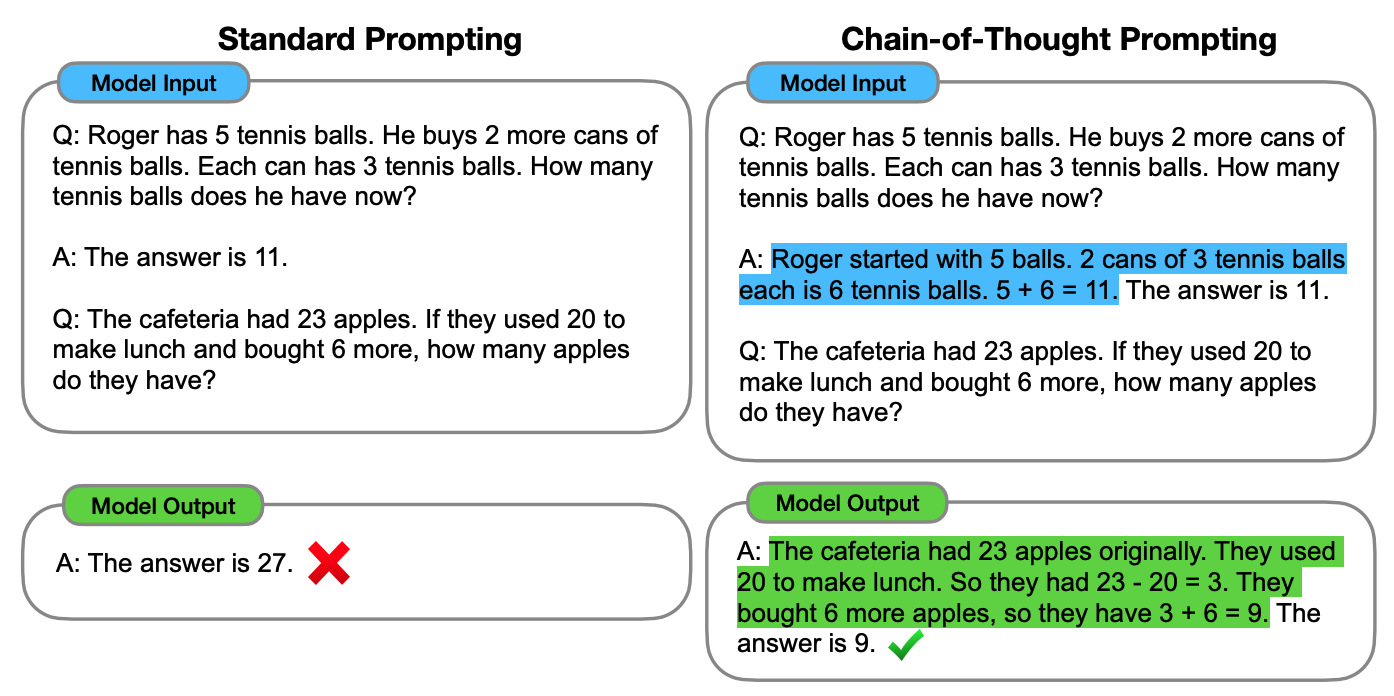
- Chain-of-Thought (CoT)
CoT focuses on the reasoning process, and its purpose is to guide LLM to learn step-by-step reasoning. The detail is in the paper[1] and I use the picture in this paper as follows:
Something (points or expression) needed to be clarified
1. there is no universally recognized definition for LLMs and fine-tuned models
In the paper, the author defines the LLMs and fine-tuned model as follows: LLMs are huge language models pretrained on large amounts of datasets without tuning on data for specific tasks; fine-tuned models are typically smaller language models, which are also pretrained and then further tuned on a smaller, task-specific dataset to optimize their performance on that task.
Based on this definition, I have a question that the LLMs and fine-tuned models are somewhat similar to the teacher models and student models in the knowledge distill models?
Something (points or expression) needed to be clarified
1. there is no universally recognized definition for LLMs and fine-tuned models
In the paper, the author defines the LLMs and fine-tuned model as follows: LLMs are huge language models pretrained on large amounts of datasets without tuning on data for specific tasks; fine-tuned models are typically smaller language models, which are also pretrained and then further tuned on a smaller, task-specific dataset to optimize their performance on that task.
Though this definition, I have a question that the LLMs and fine-tuned models are somewhat similar to the teacher models and student models in the knowledge distill models?
Appendix
- zero-shot learning, one-shot learning and few-shot learning
Zero-shot learning: Based on the zero-shot learning, the model can use some auxiliary information to infer the information to the unseen types.
One-shot learning: This method uses the infomation obtained from the former information to summarize the feature and infer the unseed samples. For example, here is a task that is needed to recognize a car. The one-shot learning is not to identify a specific car, but to determine whether image A is equivalent to image B.
Few-shot learning: Learned from a small number of labeled examples.
This work focuses on the practical aspects of working with LLMs in the real world and downstream NLP tasks.
So we can consider this paper as a beginner's guide ,though the user maybe unfamiliar with LLMs.
Refference
- Wei J, Wang X, Schuurmans D, et al. Chain-of-thought prompting elicits reasoning in large language models[J]. Advances in neural information processing systems, 2022, 35: 24824-24837.